Under a Welsh Sky, the Modern World Fades to Black
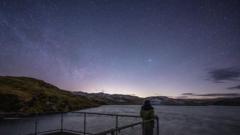
The initial disappointment was palpable. After a long drive into rural Ceredigion, all I found was a blanket of cloud. True darkness, it seemed, was playing hard to get. Then, just past ten, the sky performed its magic trick. The clouds vanished, and a universe of stars, sharp and countless, took the stage.
I was in Gogoyan with Sian and James Harrison, who had traveled from Cardiff for this. Our guide, Dafydd Wyn Morgan of Serydda, laid out blankets. We lay back, and with the aid of a green laser, he sketched the heavens. Jupiter glowed. Orion’s Belt, a favorite for James, pointed to stellar nurseries. “I’ll focus on something and it’s 150 million light years away,” James said, a note of awe quieting his voice. “I can’t quantify that.” A profound calm settled in; this was the same sky my ancestors knew.
Wyn Morgan calls it star bathing. It’s less about astronomy lectures and more about the emotional weight of the moment. The experience, he finds, often sparks a deeper curiosity. Later, by Llyn Teifi lake, he urged us to breathe deeply. “Cool, cold, fresh, and pure,” he said. “Like drinking water from a well.”
This craving for darkness is growing. Dani Robertson, a Dark Skies Officer in Snowdonia, explains why: 98% of people in the UK live under light-polluted skies. “We’re getting to the third or fourth generation who see very few stars,” she notes. Her events—stargazing, night hikes, meteor watches—have long waiting lists. One attendee, finally seeing shooting stars on his 50th birthday, wept.
Research supports the pull. Annalisa Setti, a psychologist at University College Cork, says observing nature induces a state of ‘positive relaxation,’ quieting the brain’s negative feedback loops. But the view is fragile. Robertson warns light pollution is increasing, disrupting both human health and wildlife. The fixes, however, are straightforward: better outdoor lighting, and simply switching off.
As the night deepened past 2 a.m., a faint, ethereal smear materialized above the Cambrian Mountains. It was the excited whispers of Sian and James that made me understand—I was looking at the arm of our own galaxy. We fell silent, staring at the immense, dusty swirl of billions of suns. “To appreciate the beauty, the majesty and the scale of it,” James said finally. “It’s just amazing.”