The Train That Turns the Southwest Into a Living Storybook
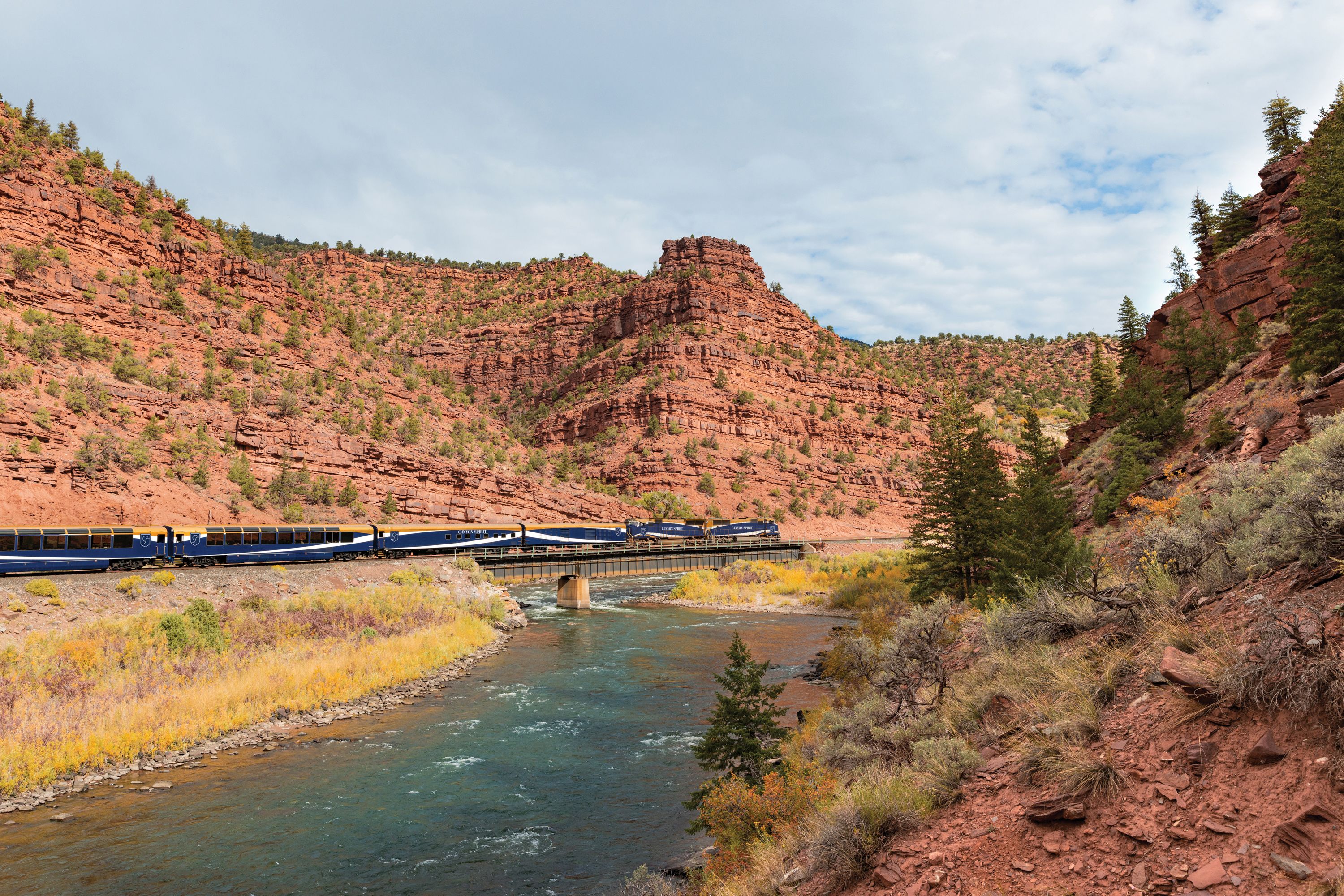
On my first journey into the desert, I’m struck by how the dry, dusty expanse of red rock feels as vast as an ocean. “It makes you feel so small,” a passenger whispers as we glide through southern Utah’s shifting scenery aboard the Canyon Spirit. It’s hour four of our three-day trip, and I’ve stopped trying to photograph every vista. Instead, I surrender to the rhythm of the train—a rare surrender that only happens when you can’t pull over or change course. I drift in and out of daydreams, watching the desert bake in the afternoon sun from my leather seat. As we head south, Utah’s harsh granite gives way to soft sedimentary layers, pine-dotted mountains replaced by pale sandstone mesas.
I’m one of the first passengers on this new route, called “Rockies to Red Rocks,” launched in April by Rocky Mountaineer. Over three days, our blue-and-gold train carries us from Salt Lake City to Denver, with overnight stops in Moab and Glenwood Springs. This is the only passenger train that stops in Moab, the gateway to Arches National Park. The itinerary is built to showcase the wild magic of the American Southwest—a region defined not by borders but by the colors in the rock.
Outside Moab, a band of light-green jade cuts through pale pink cliffs. The desert’s dehydrated palette shifts with every change in light, making it impossible to name the colors. As writer Ellen Maloy once noted, “Colors challenge language to encompass them. There are more sensations than words.”
Our hosts, Mike Hannifin and Olivia Lopez, bridge that gap with stories. Whenever the train passes something noteworthy, they share tales—from Green River’s Cold War missile testing site (now a melon farm) to Grand County’s reputation as a UFO hotspot. The train’s real differentiator isn’t the cocktails or gourmet meals; it’s the artful storytelling. The company does journalistic-style research, unearthing local lore that fills a 50-page binder onboard. Train manager Chris Woods spent two years on research, visiting tiny museums. “Some of the best stories aren’t online,” he says.
As we pass a sculpture of a horse in a red hazmat suit at Rocky Flats—a former nuclear weapons plant turned wildlife refuge—Woods explains the artist’s reminder of the site’s legacy. “Human interest stories resonate,” he says. “Yes, we talk about the rocks, but finding a human story along the way is important.”
Earlier, as we rolled along Ruby Canyon, Mike told us why some mesas have pale green stripes. “If you dig into an anthill along the tracks, you’ll find fossilized shark teeth,” he said. “A hundred million years ago, this was an ancient sea.” The green tint comes from iron deposits in volcanic ash that turned green underwater, the opposite of how iron rusts in air. I stared at the desert, trying to picture millions of years of history in the exposed earth. “So that rock was around when dinosaurs existed?” I asked. Mike reminded me that Earth itself is just a really old rock—4.5 billion years of history always beneath our feet. It just takes salt, erosion, and a good storyteller to reveal the hidden layers.
The Canyon Spirit offers all-inclusive packages with daylight-only train service, regionally inspired meals, drinks, overnight hotels, and luggage transfers. Some itineraries include off-train experiences, like guided tours of five national parks. Ticket classes range from the Signature Experience with reclining seats and an open-air car, to the Premier Upgrade with elevated dining, wine pairings, a lounge car, and a second outdoor viewing area.