Samarkand Balances Silk Road Heritage With Tourism Boom
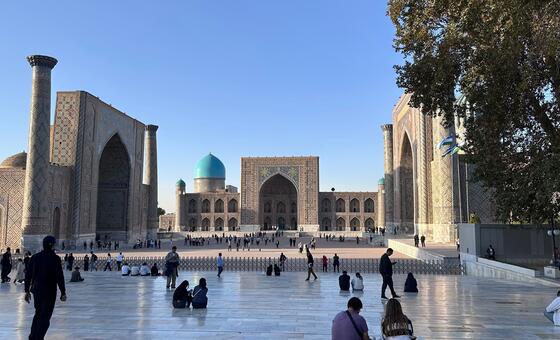
As dusk falls over Samarkand's Registan, lights come on across the turquoise mosaics and tourists linger at the stalls. The square anchors a UNESCO World Heritage site, but this is no open-air exhibit: schools, shops and workshops operate among the monuments, and old neighbourhoods sit beside new districts.
Ahead of World Cities Day, UN News asked how the city can preserve its heritage while it keeps growing. That question drives the Silk Road International University of Tourism and Cultural Heritage, whose rector, Professor Muhsinjon Kholmukhamedov, described Samarkand as a centuries-old crossroads for trade, ideas and crafts that flourished in the eighth and ninth centuries and again under the Timurids.
The university began working with UN Tourism in 2023 and renewed the partnership this year. It is translating the organization's online academy courses and preparing Central Asia's first INSTO tourism observatory, which will track visitor numbers alongside tourism's effects on jobs and residents' daily lives.
Restoration is another strand of its work. Kholmukhamedov said 1990s repairs used gypsum, concrete and rebar, and researchers now recommend modern composites that do not damage historic fabric. Laser scanning builds 3D models that flag dangerous deformations early.
Growth is rapid. Kholmukhamedov said Uzbekistan drew about 1.2 million tourists in 2016 and nearly 12 million in 2025. He estimated Samarkand alone received around seven million visitors last year, and the city expects roughly 14 million by the end of 2026. Many come for Samarkand palov, the layered rice dish whose culture is on UNESCO's Intangible Cultural Heritage list.
Housing is the pressing question, matching this year's World Cities Day theme of affordable housing. More than 1,100 apartment buildings have gone up in Samarkand Region over eight years, and UN-Habitat is developing the country's first Samarkand Housing Profile with the national Government.
Katja Schaefer of UN-Habitat said heritage includes the mahallas, the traditional neighbourhoods where community life happens. She argued for upgrading homes and services in place rather than replacing them, and for involving residents in decisions. "Our generation's task is to preserve Samarkand while making it future proof," she said.
In August, Samarkand and Tashkent joined the FAO's Green Cities Network. Schaefer said the city's greatness came from being a meeting place, and under Ulugh Beg it became a leading centre of astronomy, mathematics and science.