Palm Springs Endures as a Desert Dream
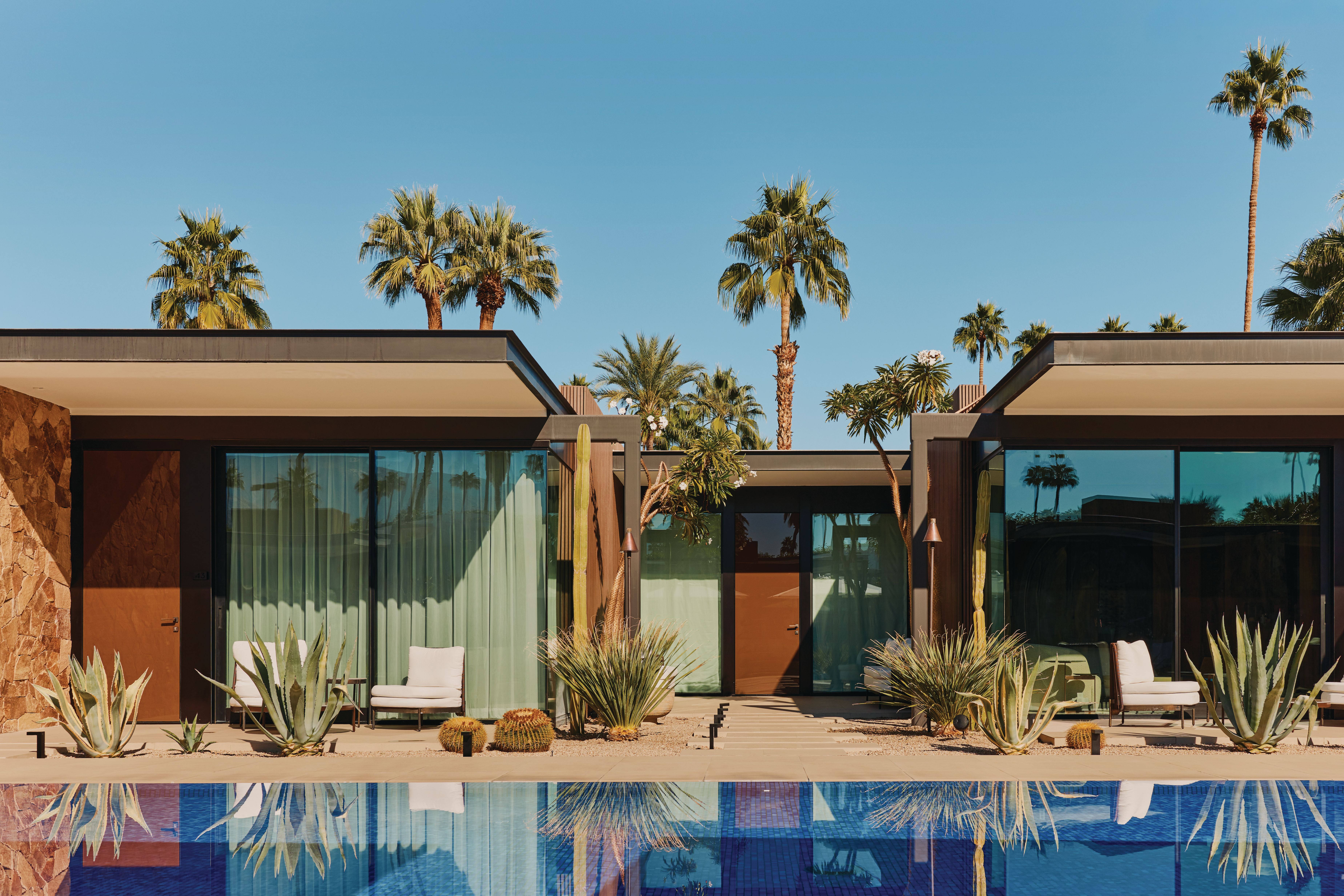
A whisper cuts through the quiet at the Parker Palm Springs: “Lady Gaga just stayed here.” We’re admiring the Gene Autry House, a bungalow on the hotel’s lush grounds. This place has layers. Built in 1961 by the Singing Cowboy, later owned by Merv Griffin, it was reimagined by designer Jonathan Adler in orange lacquer and Moroccan textiles. “The Parker is where you fall for Palm Springs,” my companion says. For me, and for the grooms whose wedding I’m attending, it was our first stop in the city years ago. On their final night, framed by fuchsia bougainvillea, we raise a glass not just to the couple, but to the town itself. “This is where we come to dream,” one groom says.
That dream has deep roots. The Agua Caliente Band of Cahuilla Indians first found healing in these springs. Later, health seekers and then Hollywood arrived, drawn by sunshine and a two-hour studio contract clause that gave stars a discreet escape. That legacy of sanctuary shaped everything.
On a surprisingly rainy day, I check into the Morse House, a midcentury modern landmark in Vista Las Palmas. Its clean lines against the San Jacinto Mountains speak to a design ethos written into the city’s postwar codes. The rental agent, Doug, calls it a masterpiece. “You can swim right up to your own bar,” he notes, pointing to the trapezoidal pool.
“Which Palm Springs are you?” a salesperson at The Webster asks me later, sorting through style tribes: midcentury modern, Hollywood regency, festival girls. The question lingers. At the Tropicale restaurant’s bar by 6:05 p.m., I find a row of men in colorful short-sleeve shirts. Derek, a retired agent next to me, explains the town’s evolution. “The creative community has grown,” he says, pointing to new bars and boutiques.
At Market Market, a vast vintage store, owner James Morelos confirms the shift. “The scale and the level are different now,” he says. With a major film festival anchoring awards season and new hotels opening, the energy is pulling talent in, not pushing it out. “Kids are staying.”
That evening, drag queen Trixie Mattel, who recently opened the Trixie Motel, puts it plainly: “The entire town welcomes originals.”
Later, over a drink at the new Beaton’s bar, John Janulis, a developer behind several hot spots, considers the moment. “It’s not that the old Palm Springs is back,” he says. “This town has always served desire. It always will.” Under 350 days of sun, that promise continues to draw dreamers, just as it has for a century.