Kamchatka's Breathing Earth: The Restless Valley of Geysers
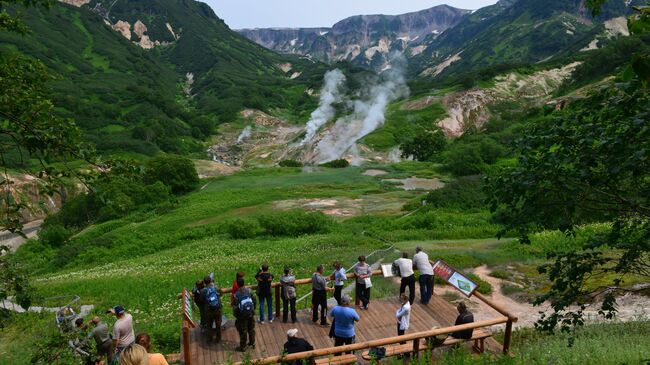
Hidden within the remote Kronotsky Nature Reserve on Russia's Kamchatka Peninsula lies a place where the earth exhales. The Valley of Geysers is a four-kilometer-wide canyon, carved by the Geysernaya River, holding one of the planet's largest concentrations of geysers. Its discovery story reads like an adventure tale. In April 1941, geologist Tatyana Ustinova and reserve ranger Anisifor Krupenin were resting by the Shumnaya River when a jet of boiling water and steam erupted from the opposite bank. 'We were terribly frightened,' Ustinova later wrote, describing the moment she realized they had found a geyser, which she named 'Pervenets,' or 'Firstborn.'
This valley is a living laboratory. Beyond the roughly two dozen major geysers—with evocative names like 'Giant,' 'Sugar,' and 'Pearl'—are hundreds of thermal springs, mud pots, and steaming fields. Each feature has its own personality, from the 'Giant's' towering 25-meter plumes to the brief, rhythmic bursts of 'Five-Minute.' The ecosystem is uniquely fragile, hosting specialized bacteria, algae, and plants that thrive in the heat.
Access is deliberately restricted to protect it. After a surge of visitors in the 1970s, the reserve was closed until 1993, when regulated tours with boardwalk trails began. The valley itself is dynamic and defiant. A massive 2007 landslide buried nearly two-thirds of the area, damming the river and submerging several key geysers. Yet, the valley adapted; most features eventually revived, and new ones emerged. Each spring, a 'month of silence' halts tourism to allow wildlife, including brown bears that use the warm grounds for feeding and mating, a period of peace.
Today, scientists continuously monitor this ever-changing landscape, tracking the geysers' pulses and studying its resilient life. For the few visitors permitted, it offers a profound glimpse into a world where the planet's inner forces are on vivid, steaming display.