Greece's Submersible Bridges at the Corinth Canal Are an Odd but Fascinating Sight
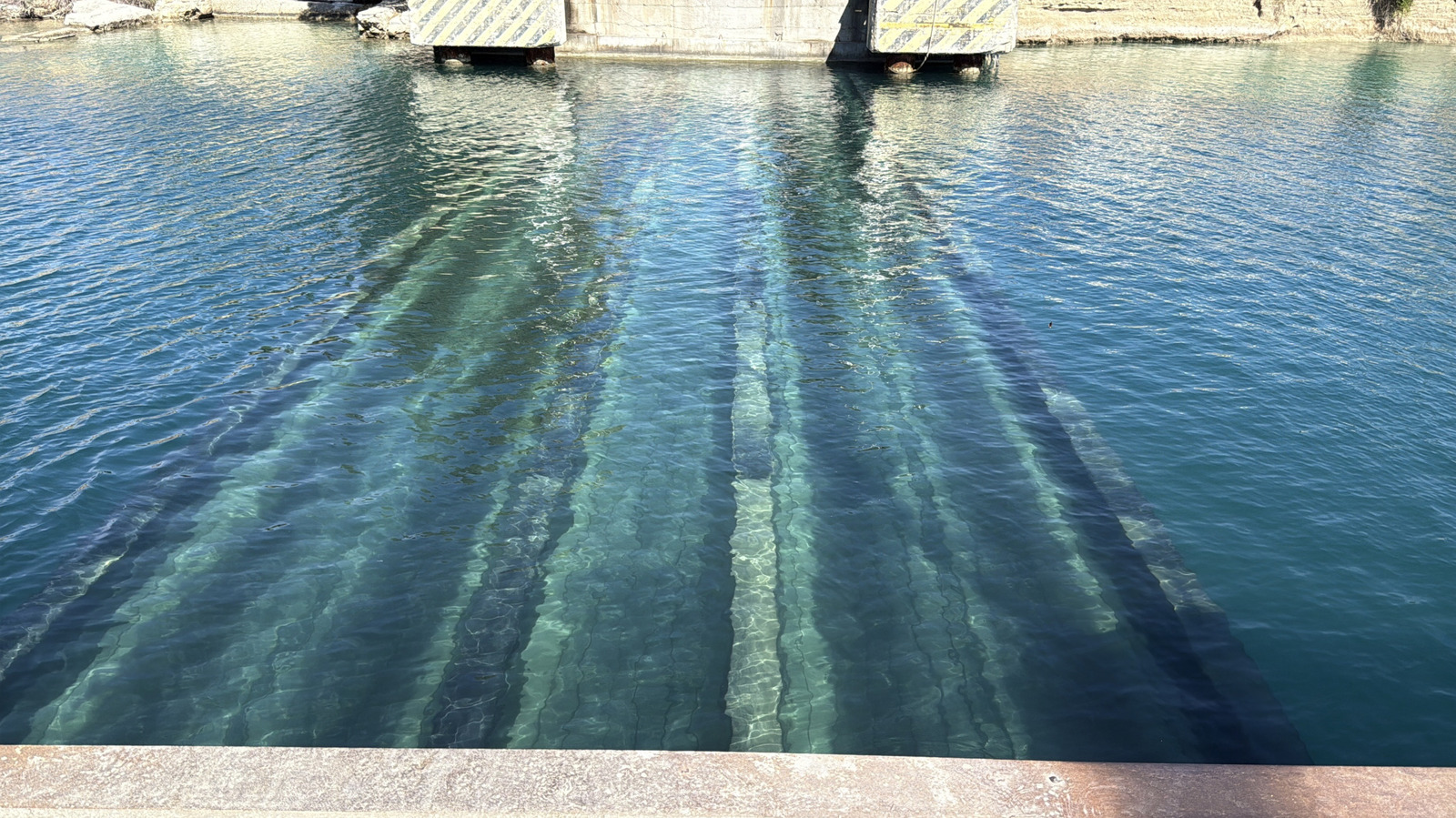
Greece draws visitors for its ancient sites, its islands and coastal towns, and its food. Those are the usual reasons to go. But there's something else worth seeing: the two submersible bridges on the Corinth Canal that link the Peloponnese, specifically the Isthmus of Corinth, with mainland Greece.
Most of the world solved this problem long ago with drawbridges that lift or swing open in one or two sections so boats can pass through the middle. The Greeks took a different route at two points on the canal, building bridges that simply sink. It's fascinating to watch in action, as I did on a recent vacation, and also a bit silly. The rest of the world seems to agree, since only two exist, one at each end of the canal.
Each side of the bridge has two large hydraulic lifts that raise and lower the 108.3-foot-long wooden roadway, which includes a footpath between the lanes so people can walk across. One drawback: the footpath is slippery right after it comes out of the water. It's a small price to pay for such an engineering marvel.
The two traffic lanes plus the footpath make the bridge 23 feet wide. It's unclear exactly how much power the lifts produce, but the roadway is lowered more than 26 feet, so a lot of saltwater holds it down. According to AllOverGreece.com, the bridge's maximum allowed uniform load is 7,119 pounds per square foot, so it's sturdy, and those motors provide serious pulling power.
The main selling point is that the bridge won't obstruct a ship. Even a conventional drawbridge has height limits, whereas this one does not. There is a lower limitation now, which can hamper how large a ship can be that goes through the canal, especially a sailboat because of its keel. The Greeks aren't too worried, as the bridges have been around since 1985 and are still going.
There are practical issues like speed. With so much weight involved, the bridge moves vertically at 13 feet per minute, so sinking or refloating takes about three and a half minutes in each direction. For safety, the bridge is sunk a full 15 minutes before a ship approaches. That's a long time, especially as traffic piles up.
Onlookers pile up too. These bridges draw a crowd. While visiting the bridge in Corinth, my fiancée and I were two of no fewer than a dozen people standing on either side watching it go up and down, and that doesn't count the restaurants on both sides of the canal with outdoor seating meant specifically for watching the submersible bridge in action.
People love these things. Like Greece itself, the submersible bridge is a bit nonsensical and silly, but it's also a fascinating thing to see in action. I won't tell you to take a 10-plus-hour flight to Greece just to check it out, but if you're there, it may be worth stopping by. Grab a bite while you're there. Nobody is in a rush. The Greeks certainly aren't.