Calabria: Italy’s Last Great Secret, One Summer at a Time
There’s a moment, not long after you arrive in Calabria, when the modern world starts to feel like a rumor. I was in Pizzo, standing inside Antonio Montesanti’s pottery studio, when he started talking about Achilles. Outside, Vespas buzzed past. Inside, the painter—wearing a straw hat and a knowing smile—explained that local fishermen still scratch a crosshatch pattern into the cheeks of swordfish they catch. It’s not a superstition, he said. It’s a ritual. Those fish, according to legend, carry the souls of Achilles’ Myrmidons. You hear something like that and suddenly the scooters sound like mules.
Later, in Nicotera, I saw three boys reenacting a medieval love story with cardboard boxes on their heads and wooden chairs on their shoulders. No video games. Just a drum, some dishwashing gloves, and the sheer joy of pretending. Their giant papier-mâché figures, called Giganti, are usually saved for feast days. But this was a Tuesday in July. They just felt like playing.
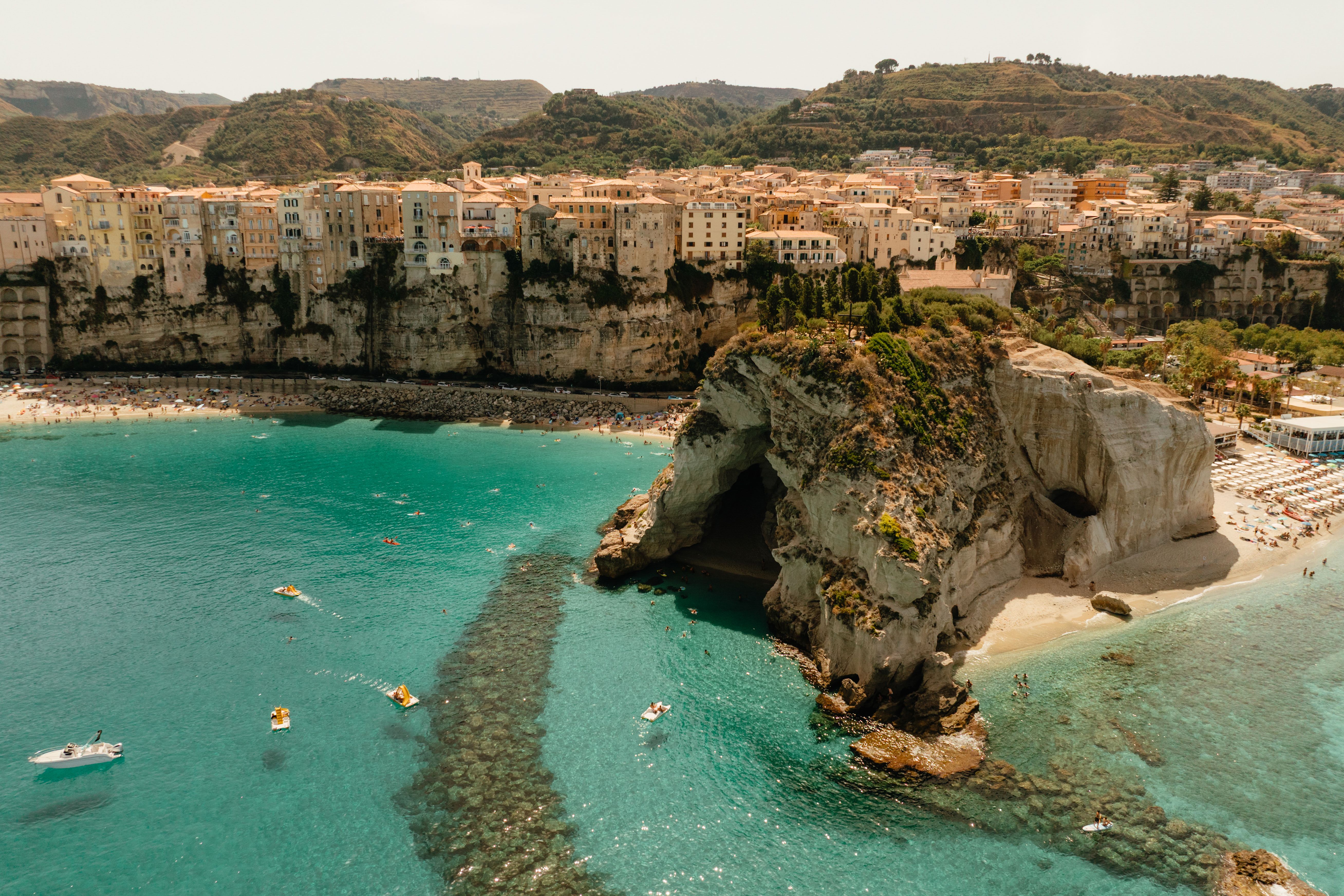
That’s the thing about Calabria. It’s not trying to impress you. It doesn’t have to. Gary Portuesi, who runs Authentic Explorations, calls it “Sicily 20 years ago.” He should know—he helped launch Sicily’s high-end tourism wave. Now he’s betting on this overlooked toe of Italy, where long white beaches alternate with rocky coves along the Costa degli Dei, and where Tropea’s sandstone palazzi and medieval cathedral feel like they’ve been waiting for you.
You could spend a week in Tropea without a car, eating swordfish in elderflower marinade at Le Mura, watching the sun set over Stromboli. But the real magic happens when you venture inland. In San Floro, a cooperative called Nido di Seta has planted thousands of mulberry trees and revived Calabria’s ancient silk trade—so successfully that Gucci now buys from them. In Martone, chef Pino Trimboli serves organic pasta on terra-cotta roof tiles. And in Cutro, a humble gelateria called K2 serves a coffee stracciatella that tastes like it was made by alchemists.
Calabria is not polished. It’s dusty, sometimes chaotic, and full of unfinished concrete blocks next to Byzantine churches. But it’s also full of people who don’t realize what they’ve got. Like Elisa Loiacono, who mentioned a place called Le Breste in the hilltop village of Brattirò. “Only we locals go,” she said. It turned out to have sunset views, heirloom pasta, and a wine list full of native grapes. We booked an hour before dinner.
This is the Italy you thought didn’t exist anymore. It does. It’s just hiding in plain sight.